
Opening hours for Christmas 2025 and January 2026
Opening hours for Christmas 2025 and January 2026
Wednesday 03/12/2025 – last accept order for delivery in this year
Friday 19/12/2025 – OPEN – 7:00 a.m. to 1:00 p.m.
Monday 22/12/2025 to Wednesday 07/01/2025 – CLOSED – ANNUAL INVENTORY
From Thursday 08/01/2025 – OPEN – 7:00 a.m. to 3:30 p.m. (standard operation)
Technical information

.svg)
VÝPOČET HLAVNÍHO ODVODNĚNÍ
VÝPOČET POJISTNÉHO ODVODNĚNÍ
IČ: ____..27377377
DIČ: ___CZ27377377
Pozn. U kapacity vpustí nebo chrličů jsou v závorce uváděny normálové hladiny vody na střeše.
Pozn. U kapacity vpustí nebo chrličů jsou v závorce uváděny normálové hladiny vody na střeše.
V případě dalších dotazů nebo upřesnění jsme k dispozici na kontaktech technické podpory.
Telefon: +420 777 701 241
E-mail: podpora@topwet.cz



The roof outlet is always installed as the bottom part (which is why its name includes the external diameter for connection to the downstream rainwater pipe), and the extension is always inserted into the roof outlet. The neck of the roof outlet—i.e. its upper part—has a universal diameter of approximately 130 mm, regardless of whether the roof outlet is DN 70, DN 100, or DN 125. The extension can be inserted into all of these diameters. The opposite configuration is not possible.
No, it does not. A seal must always be inserted into the neck of the roof outlet, especially in case of heavy rainfall, when the rainwater piping may become overloaded and backflow pressure could allow water to penetrate into the thermal insulation layer. For draining water from the vapour barrier, we offer a dedicated special product—a separate small roof outlet installed next to the rainwater downpipe, equipped with a transparent inspection chamber and a non-return valve that protects the entire system against water backflow.
During construction, they serve as reliable temporary drainage, as the subsequent layers of the roof structure may be installed several months later. For the building itself, their key function is to provide a secure connection to the vapour barrier layer. This means that the vapour barrier is not perforated at the point where the roof outlet is installed, preventing the risk of moisture-related defects.
In most cases, the roof outlet (the bottom part) is heated, as this allows the power supply cable to be easily routed below the ceiling, where it is then connected by electricians. Heating of the upper part can also be provided; however, it introduces unnecessary technical complications related to routing the power supply cable below the ceiling.
The minimum thickness of thermal insulation at the roof outlet location is 40 mm. With a thinner insulation layer, the extension cannot be inserted due to its design.
Self-regulating roof outlets are equipped with a semiconductor heating system that adjusts its output according to the ambient temperature; however, it cannot switch itself off completely. The operating voltage is 230 V / 50 Hz, so no expensive transformer is required for connection.
- Permanent connection without a switch (not recommended, as electricity is consumed even during summer)
- Manual switch to interrupt the phase and thus cut off the power supply during the summer period
- Timer socket (annual)
- Thermostat, ideally set within the range of +3 °C to −10 °C; if only one temperature setting is possible, it should be set to +3 °C. In practice, this means that once the temperature drops below 3 °C, the thermostat activates the heating of the roof outlets and prevents freezing in critical temperature conditions around 0 °C.
If an unheated roof outlet has already been installed, it is not necessary to replace it with a heated version. Instead, a heating kit can be purchased. The kit includes a self-regulating heating cable for 230 V / 50 Hz AC (heating section length 0.4 m, or 0.6 m for the XL version, power supply cable length 1.5 m), two plastic mounting ties for fixing the cable to the roof outlet body, and aluminium adhesive tape to reduce heat loss.
No, the cable does not have a sensor. It regulates its output by means of a semiconductor layer, depending on the ambient temperature.
An odour trap is designed for areas with free air circulation (such as outdoor terraces and balconies). The trap does not provide 100% odour-blocking efficiency, but it offers a higher drainage capacity than a siphon and a lower risk of clogging.
A siphon is intended for enclosed spaces and areas where 100% odour protection is required. The siphon provides full odour-blocking efficiency, but has a lower drainage capacity than an odour trap and a higher risk of clogging with debris.
Yes, all TOPWET terrace accessories are fully compatible with terrace roof outlets, standard roof outlets, as well as extensions for roof outlets.
Sealing sleeves can be manufactured in a RAL colour when ordered in larger quantities. To avoid colour inconsistencies between different manufacturers, the best solution is for the customer to supply the membrane in the required colour themselves. The membrane requirements are that it must be without reinforcement (so-called detail membrane).
The bodies of these products are made of PVC material. The plastic itself is not coloured during production; the standard colours are white and black. It is possible to apply a primer to the product and then paint it with a plastic-compatible paint in the required RAL colour. The best solution is to apply the paint directly on site. This helps avoid potential damage caused by improper handling during transport or installation, which could scratch the surface and damage the colour coating.
For installation of a roof outlet into a gutter, the outlet can be factory-modified by reducing the size of the anchoring plate. Each type of roof outlet allows modifications within a different range, therefore please do not hesitate to contact our technical department regarding this matter. These product variants are not kept in stock and are manufactured to order.
The outlet body must always be fixed to the load-bearing layer; otherwise, wind suction could cause the roof outlet to be pulled out of the connected piping. The exception is when a two-stage roof outlet is used in bonded and ballasted systems—in this case, the extension does not need to be anchored, as anchoring would serve no purpose.
Polyamide is a rigid plastic capable of withstanding high loads and is very easy to machine. The manufacturing technology ensures a product with high toughness, good sliding properties, high abrasion resistance, and excellent chemical resistance.
The slats of the new leaf guard do not extend to the bottom in order to improve its self-cleaning capability. This design allows small debris, such as small leaves, to flow freely into the drainage system, while the leaf guard captures only larger debris that could potentially clog the drainage system.
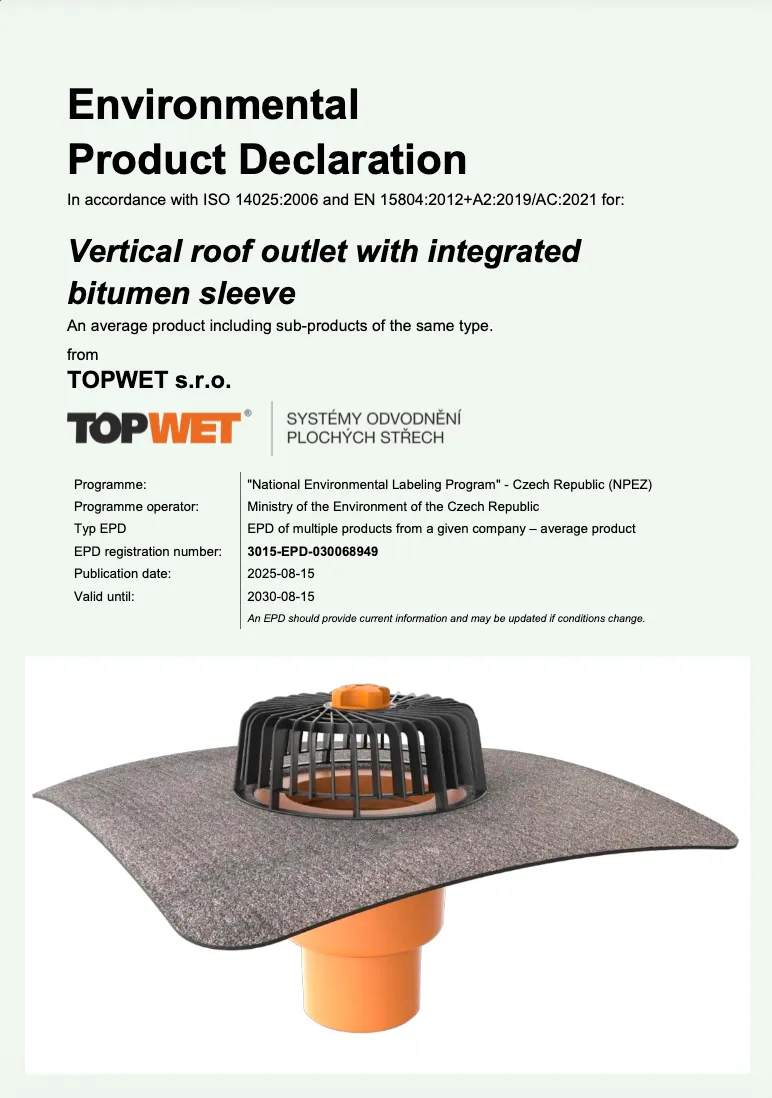
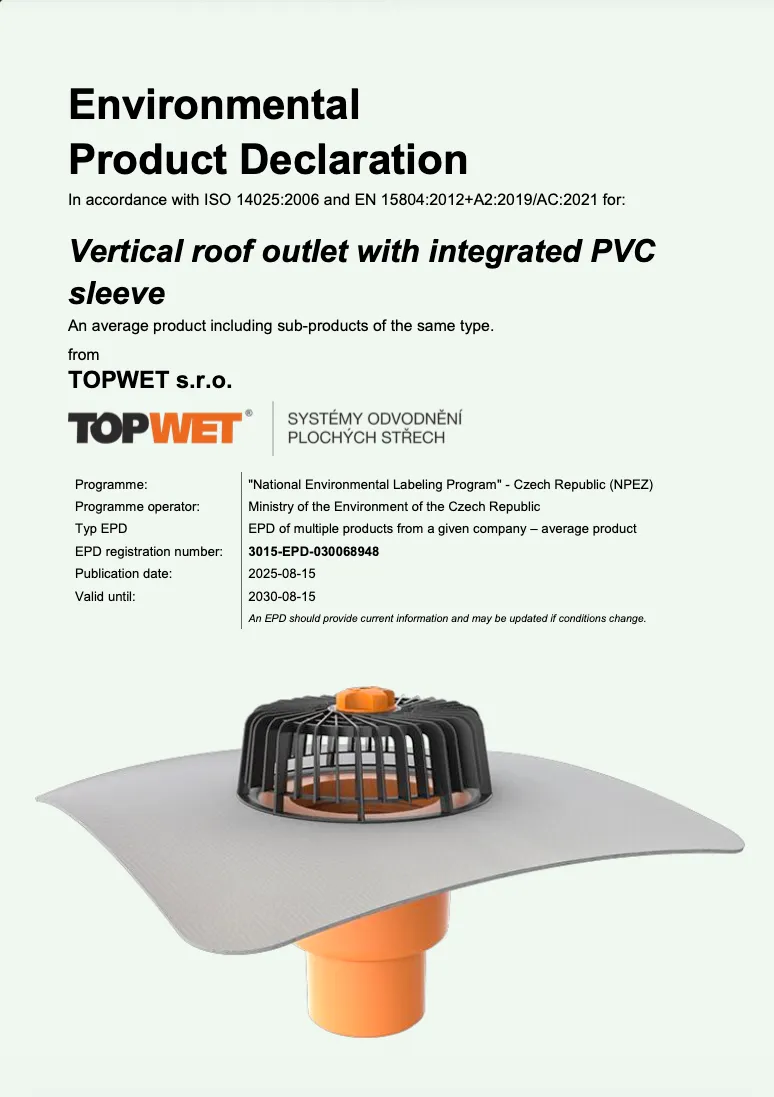
For roof outlets with an integrated waterproofing sleeve, the sleeve is firmly pressed between the roof outlet body and the upper flange, and both parts are permanently welded together using ultrasonic technology. The entire connection process takes place directly in the factory, and the manufacturer assumes full responsibility for the watertightness of this critical detail.
During installation, a major advantage is that there is no need to screw the roof outlet together. The outlet is simply taken out of the box, installed directly into the mounting opening, anchored, and the sleeve is welded.
In contrast, roof outlets with a screwed flange are supplied by the manufacturer as several separate components, and their assembly takes place directly on site, where installation errors occur very frequently. Screwed flanges may be insufficiently tightened or overtightened, and in both cases this can lead to water ingress into the roof structure. Even when the screws are tightened correctly, roof outlets with screwed flanges require not only inspection and cleaning of the leaf guards, but also regular checks of the screw tightness.